Forget-Me-Not
Myosotis
Meaning and Symbolism
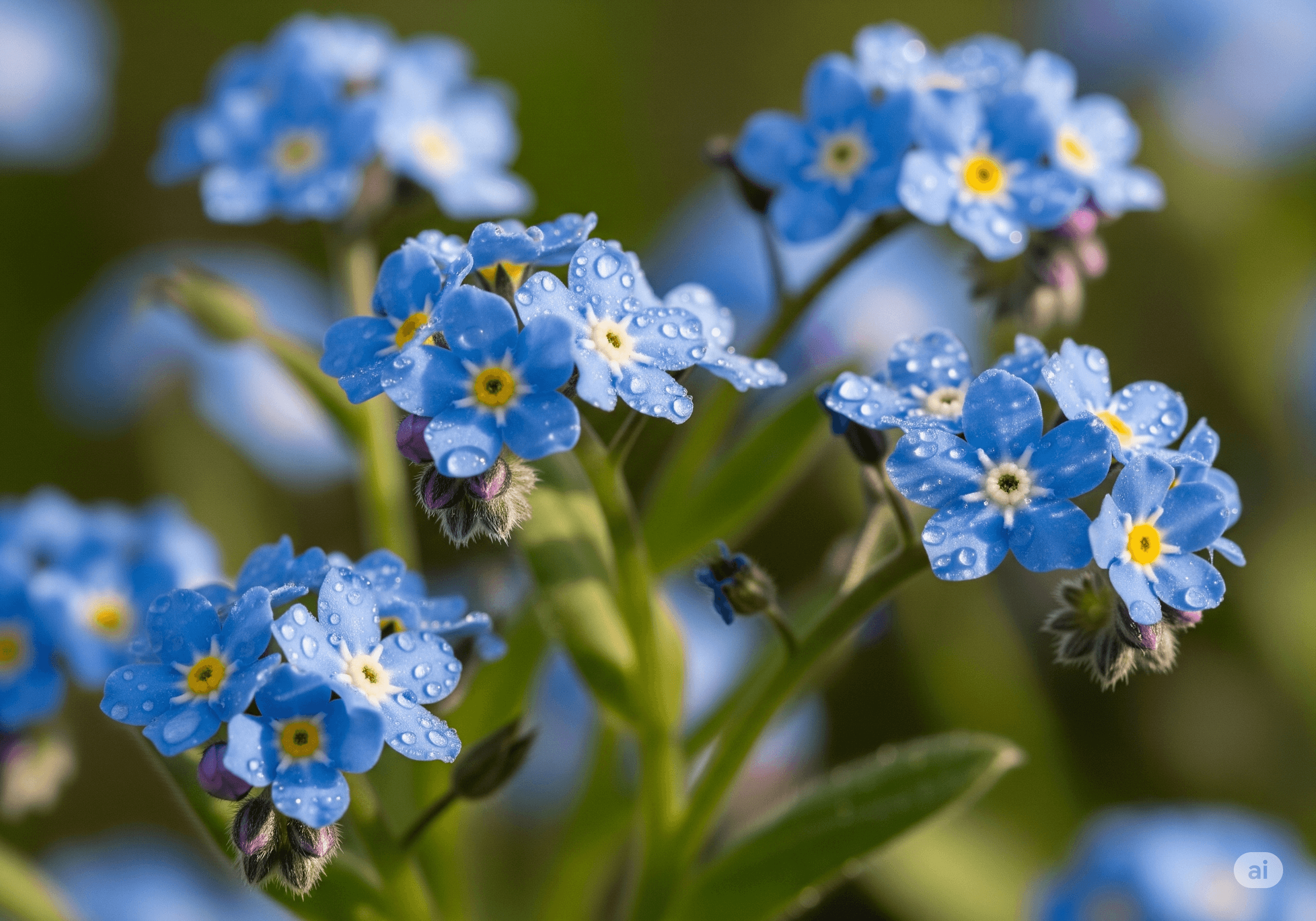
The very name “forget-me-not” encapsulates its symbolism: remembrance and enduring affection. These delicate blue flowers are exchanged as promises that a person will not be forgotten. They represent fidelity and loyalty in love – a constant memory of someone who may be apart or gone. According to legend, a medieval knight, while picking these flowers for his lady, tragically fell into a river (weighed down by armor). As he drowned, he tossed the bouquet to her and shouted “Forget me not!” – forever linking the flower to faithful love and remembrance. Forget-me-nots also convey true love and respect. They can be a comforting symbol after a loved one passes away, indicating that the loved one’s memory lives on. For friendships, they serve as a gentle reminder of genuine connection and times shared. In a broader sense, these flowers stand for memories and nostalgia – small but bright, forget-me-nots often grow in places where one may have spent a happy moment, springing up year after year like living memories. They’re sometimes worn on lapels or as emblems for causes related to memory (for example, forget-me-not symbols are used to raise awareness for Alzheimer’s disease, implying we hold onto precious memories as long as we can). In the Victorian floriography, forget-me-nots simply meant “remember me forever” and were a popular motif in jewelry like lockets and rings, further reinforcing their association with sincere, long-lasting emotional bonds.
History and Cultural Significance
Forget-me-nots are found in temperate regions around the world, and their cultural prominence is particularly notable in Europe. The scientific name *Myosotis* means “mouse’s ear” in Greek, referring to the shape of the petals or the plant’s fuzzy leaves. They became embedded in European folklore; beyond the knight’s tale, another story from Germany tells of God naming all the plants when a tiny unnamed one cried out, “Forget me not, O Lord!” – God declared that would be its name. In the language of heraldry, forget-me-nots have been used as symbols of remembrance. Notably, after World War I, forget-me-nots were worn in parts of Europe (such as Newfoundland) on Memorial Day before the poppy became widespread, to commemorate fallen soldiers. Freemasons in Nazi Germany reportedly used the forget-me-not as a secret emblem to identify each other and show unity when their organization was persecuted – another poignant instance of the flower meaning steadfast remembrance under hardship. Alzheimer’s associations around the world use forget-me-nots in logos and campaigns focusing on memory and care for the elderly, since the flower’s message resonates deeply: to remember and not forget those we love. Alaska chose the forget-me-not as its official state flower in 1917 (even before it was a state). The alpine forget-me-not, with its bright blue color, symbolized for Alaskans the far-away beauty and the enduring memory of their homeland. The flower is featured in the Alaska state song, which calls it a 'blue star of the Norland'. Forget-me-nots also appear in literature and poetry often as symbols of remembrance. They’ve been mentioned by writers like John Clare and even in one of the Sherlock Holmes stories as a motif for memory. Today, organizations worldwide use forget-me-nots in logos and campaigns focusing on memory and care for the elderly, because the flower’s message resonates deeply: to remember and not forget those we love.